[^]
Showing posts with label Interview. Show all posts

Sep 21, 2009

COMSOL – The Multiphysics Simulation Major sees huge Growth Potential in India

COMSOL plans to hold an international conference in Bangalore in November 2009, to showcase Multiphysics Simulation and modeling tools, applications and cutting edge research.

The following is the text of an interview with Svante Littmarck, who is a founder and CEO of the COMSOL Group, and President and CEO of COMSOL, Inc.

What exactly is multiphysics?

The real world consists of multiphysics. Physics is never present in a single form. For example if you put electric current through a conductor you get heat, and heat affects the resistance and brings down the current, and then the heat generation changes. It is a coupled system that interacts. If you have a light bulb, it gives light and also generates heat. Because of that there is tension in the bulb and the filament itself. There are chemical reactions and plasma reactions. In the past all these different phenomena needed to be checked through experiments which were costly and time consuming. Using multiphysics simulation tools, one can simulate various situations and models to see the effects. For a fast and accurate solution we need multiphysics simulation. I see the requirement of multiphysics simulation growing in all directions.

When was COMSOL founded, and what is the current spread?

We developed our first multiphysics modeling and simulation product PDE (Partial Differential Equation) tool box in 1994 in Sweden. In 1999 the United States office was set up to market the product world wide. We have 3 offices in the US now, one each in Boston, Los Angeles, and Palo Alto, and 16 offices worldwide. Considering the market potential in India, we started our Indian office in Bangalore last year.

What are the most recent developments at COMSOL?

COMSOL offers a broad range of physics in a single interface, making it easy for users to solve a variety of new problems. In COMSOL version 4 which is to be launched shortly, we will have a new graphical user interface and an easy to use Application Programming interface. It will have three bi-directional interfaces with Pro E, Solidworks and Inventor. The new version and the current version supports file-based import and export to a many other CAD packages. We display the laws - the complicated equations - on the lower side of the screen, for mathematically oriented users.

What are your future plans?

Regarding the future of multiphysics simulation, the way I see it, we need to integrate analysis tools with CAD packages. We need to make the software easier to use and create a graphical user environment which is close to the CAD environment. We are developing applications for CAD engineers to run analysis software, from within the CAD application.

What, in your opinion, is the potential of the Indian software market?

The Indian software market is as big as the US, French or German markets. Traditionally the industry has not been that big in India. With the GDP growth of India in the last few years, the Indian industry has grown too. So I am sure the software market here is going to become one of the largest in the world. It has the potential. It is only a question of time. Everybody is growing here.

Do you have any reservations on selling to strategic sectors such as Nuclear, Space and Defence in India?

No. We are a Swedish company, and we have no restrictions in supplying our products to these sectors.

What is the proposed modality for offering COMSOL multiphysics services in India?

We don’t directly offer software services using our tools. We partner with consulting companies that specialize in offering services using our tools, and we certify and recommend them to prospective customers. In India we are working on developing such certified consultants. We are looking for partners to work with.

What can we expect from the upcoming COMSOL user conference in Bangalore?

We are planning the first international COMSOL user conference outside of US and Europe, in Bangalore in November 2009. Attendees will benefit a lot from this conference. The training opportunities are not COMSOL-specific alone. One could use them while doing simulations. We have scheduled key notes from the Industry, paper presentations by users, and multiple training opportunities, for people to get a feel of using the products for various applications. There will be poster sessions, and I will be presenting the COMSOL road map for growth in the coming years. We are all quite excited about it. We expect important research people doing cutting edge research, people who would like to use simulation tools, as well as students who are interested in simulations, to participate in the conference.

Jul 20, 2009

Real and virtual test teams have merged - Jean Michel Terrier, Altair

"Earlier there were two teams for real and virtual tests. Now they have merged together."

"Ten to fifteen years ago simulation was the job of specialists. Now, merging with engineering teams, it is used by engineers in the product design phase itself. Anybody who is into virtual validation should take a look at the technology available," says Jean Michel Terrier, Director, Business Development, Altair - Radioss & Safety Technology.

RADIOSS, a finite element solver that simulates impact, safety-related performance and the manufacturing process, is being used in a variety of applications to improve safety features, maximize the durability of products, reduce noise and vibration, optimize designs and bring safe and innovative products to the market faster. As a powerful tool for crash safety analysis, the applications of RADIOSS include drop testing of consumer products, crash testing of vehicles and studying the effect of ballistics and explosives.

“Almost 50% of our customers are from the automotive sector, 25% from Aerospace and Defense and the remaining from various other sectors,” said Jean Michel Terrier.

"One of the strengths of Altair is 'optimisation'. We will be able to run a crash simulation in a couple of minutes so it will be possible to cover a lot of cases and to take all these cases in the optimisation loop. We also have very good knowledge and process on how to optimise structures. This significantly helps the auto industry to design new cars."

"You can have a very nice tool but if you don't know how to use it you can make a very bad simulation. Learning it is like learning to drive a car."

"In the automotive space it is quite important to model and virtually test the behaviour of the driver and the passengers with the car during the crash. Regulations regarding crash safety (Euro NCAP in Europe, FMS in United States and regulations in China, Japan and India) are being improved. From protecting the driver and passengers the rules are now being extended to protect the pedestrians as well. A good number of road-accidents are due to pedestrian impact."

"Extensive simulation work is going on using Altair tools to reduce tyre noise in speeding vehicles to conform to the upcoming regulation on tyre noise control in the US. In 2008, Ford cars which used RADIOSS for crash testing got 5-star rating in IIHS (Institute of Insurance for Highway Safety) tests in the US."

Another interesting application of RADIOSS is in bio-mechanics simulation where finite element models of human beings are used to simulate injury mechanisms, prostheses implementation and wear (e.g., hip, knee and teeth) and understanding lesion mechanisms (e.g.: sporting injuries and safety).

"Most people are working with dummies, but people want to know what happens to a real human being. Currently we are working on the human representation with finite element. We have human model and we are working to design correctly all the organs etc. Our big interest now is to grow in terms of more and more detail in bio-mechanic and to make the connection between bio-mechanic and crash-analysis," Terrier added.

In India, Altair currently employs close to 360 people for simulation software tools development, marketing, support and services. Approximately 130 people are involved in the software development side.

“In addition to offering Altair products and support, we also offer simulation services for a wide variety of CAE problems.”.said Pavan Kumar, Managing Director of Altair.

Altair is expecting a 25% growth this fiscal over last year's turnover of Rs.85 crore.

"India has a number of RADIOSS customers and the list is growing fast, " said Pavan Kumar.

IIT-Bombay evaluates static and dynamic analysis of tumour and knee prosthesis using RADIOSS which predicts critical dynamic stress and deformation areas significant to bringing design improvements for achieving the goal of developing a reliable low-cost prosthesis for Indians.

Volvo is using RADIOSS for full vehicle crash analyses and the simulation results correlate well with the physical test data. The CAE pulse from FEA crash analyses provides valuable test data which could be used confidently in many cases instead of going in for physical crash tests.

LG is using RADIOSS for drop test simulation of their air conditioners. A drop test is one of the key requirements of consumer electronic products. The simulated results were found to be in correlation with the actual experiment data.

Its other customers in India include Bajaj, Maruti Suzuki, TVS, Leyland, Volvo trucks, Piaggio, Federal Moghul, NAL, HAL, TAML, GE Tech center etc.

Apr 28, 2009

Current and future trends in product engineering, application development, technology consulting - KPIT Cummins

Prabhakar Bendre, Senior Vice President - Manufacturing Business IT, KPIT Cummins Infosystems Ltd., talks about the Current and future trends in PLM, The Market size for PLM and for CAD CAM software, How PLM and MES help organizations during the Slow down and the Growth and future operation plans of the company.

1.
Could you please tell us about the services offered by KPIT Cummins? Which segment of the Industry do you focus on for your services? What are your core competencies in addressing this segment?

KPIT Cummins is a global IT consulting and specialist solutions partner to manufacturing corporations with focus on automotive, hi-tech and industrial verticals. We engage with our customers to combine technology and process expertise to help them bring products faster to their target markets. As leaders in our space we co-create domain-intensive technology solutions to help companies become efficient, integrated and innovative manufacturing enterprises. We currently partner with 100+ global Manufacturing corporations including 50+ OEMs (Original Equipment Manufacturers), Tier 1s and semiconductor companies.

Our services span across product engineering, application development, technology consulting, Enterprise IT, Business Intelligence and specialized BPO/KPO. We are SAP channel partners and we are consulting partners for Business Objects.

We are premium members of AUTOSAR and member of JASPAR. We are one of the very few SPICE® level 5 certified companies in India.

2. Which are the PLM platforms you work with?

The PLM practice at KPIT Cummins is fast emerging as a comprehensive provider of digital manufacturing solutions to companies in the area of automotive, hi-tech and industrials verticals. We deliver end-to-end PLM Implementation services that include Solution Architecting, Deployment, Integration, Data Migration (from ERP/ Legacy Systems), Maintenance and Support. These services are primarily offered on three platforms namely – Enovia, Windchill and Oracle Agile. We have also partnered with Dassault Systèmes to deliver pre-configured Enovia implementation templates for Indian automotive and Industrial manufacturers. We have a partnership with Oracle India to sale and implement Agile PLM tool

3. How will the PLM and MES help organizations during this Global Economic Slow down?

Today companies are facing pricing pressure from the customers. At the same time to maintain profitability they have to reduce costs and increase service levels. Manufacturers are thus exploring opportunities to run their people-intensive operations from countries that offer significant cost arbitrage. The design teams are distributed across geographies and they need a common information platform to collaborate on a real-time basis. PLM and MES address these challenges, ensuring the products get to the market faster – while complying with stringent quality norms.

PLM and MES represent the fast emerging manufacturing concept of Digital manufacturing, a process / tool to design, validate and establish the POC for a new product, the manufacturing process and equipment required. It does this by way of translating the design data into virtual manufacturing process. A process that includes a detailed plan, assembly definition, assembly line design, plan for manufacturing cells, workstations, associated quality measurement systems, operating instructions and necessary documentation.

This allows flexibility and adaptability to operations such that processes can be shifted / switched dynamically to respond to the market conditions and opportunity in real time.

To help realize the full benefits of digital manufacturing investments, manufacturers need to integrate production systems across the organization, from design to quality monitoring. This encompasses integration of enterprise resource planning (ERP), product lifecycle management (PLM), manufacturing execution systems (MES) and Shop Floor Control systems, to ensure seamless transmission of design information to the manufacturing line. This helps customers streamline and globalize their processes faster, facilitating them to become efficient, integrated and innovative enterprises.

4. What are the new services and market verticals on the radar of the Company?

Manufacturing Execution System (MES) is the next logical extension of our services portfolio. Faced with dynamic market changes and competitive threats, industrial manufacturers are broadening their focus from execution within a single facility/factory to manufacturing operations management across the supply network. As a result, Best-in-Class manufacturers are more likely to implement Manufacturing Execution System at their locations to:

1. Use automated data collection in conjunction with data historians and manufacturing analytics.
2. Standardize Key Performance Indicator measurement, optimization and exception handling across the enterprise.
3. Link operational metrics with financials and provide real time role based visibility to decision makers.
4. Use Plant floor automation (PFA), Quality Management Systems (QMS), Manufacturing Intelligence (MI), and Advanced Planning and Scheduling (APS).

At KPIT Cummins, we partner with global manufacturers of Construction & Farming equipment, Mining & Power machinery and Machine tools. With MES we address the customers’ operation issues thus enabling them to optimally plan, schedule, sequence, execute, and monitor all their manufacturing processes, achieve on time delivery, Increase Overall equipment effectiveness, institutionalize lean Six Sigma processes, monitor production to drive continuous improvement, reduce labor costs and to achieve higher profits and marketplace wins.

5. Who are your major clients in India and abroad?

We work with leading automotive OEMs, Tier 1s and semiconductor companies globally.

6. Continental India recently inaugurated its Technical Center in Bangalore. Could you please tell us about your alliance with the Continental Technical center?

We would not be able to comment on this.

7. What are your growth plans and future operation plans of the company?

Since we articulated our Go-to-Market strategy and indentified focus verticals we have experienced significant traction for our services and delivery models. We have acquired leading automotive OEMs, Tier 1s and semiconductor companies as customers. We would continue to deepen our engagement with these customers and would explore opportunities for joint project development and co-creation of IP.

Our growth has been encouraging and we have done 5 acquisitions in the last six years. We continue to look for opportunities that allow us to strengthen our positioning in delivering services to manufacturing companies in our focus verticals. But our focus of growth is largely organic and focused on higher value generating solutions for our customers.

8. How do you differentiate your company, compared to other players offering PLM products and services?

In the current economic scenario manufacturers are looking at making investments in solutions that ensure quicker Returns on Investment, reduced cost of ownership and long-term business benefits. Our PLM service delivery methodology ensures that customer imperatives are met with customized solutions. Following are the core differentiating factors between services by KPIT Cummins and other providers:

1. Domain expertise: we have deep domain knowledge and understanding of the three core verticals namely Automotive, Hi-tech and industrials.
2. Integration capability: we have the capability to offer solutions that integrate PLM with MES (Manufacturing Execution Systems) and ERP.
3. Well Defined PLM implementation Methodologies - Customers leverage PLM implementations based on methodical approach using pre-configured templates, that reduce implementation time and costs

9. Could you please tell us about the current and future trends in PLM?

There are few broad trends in PLM:

1. The use of PLM authoring tools such as CAD-based solid modeling – by domestic Indian companies - which is already widespread; the need now is more for collaborative product life management solutions.
2. In case of Global MNC companies, leading engineering companies such as ABB, Volvo, Chrysler, and GM are setting up engineering centers here in India and are looking at partnering with companies like KPIT to expand their design capacity. These companies are also looking at starting captive design capability.
3. The other trend seen is that domestic manufacturers who were earlier India focused are now going global. Take for instance Bharat Forge, which has emerged as the second largest forging company in the world. It has expanded aggressively overseas. Therefore the kind of solutions these companies need have to be of global standards and not just product-focused but also increasingly process-focused.
4. Most of the Customers are looking at pre-configured solutions that reduce implementation time and result in quicker Returns on Investments.
5. Integration with MES and ERP systems is emerging as a critical success factors for manufacturers.

10. What is the market size for PLM and for CAD CAM software globally and in India

1. The overall PLM market grew at a healthy clip of 10% CAGR, even amid global economic turmoil, thanks to emerging geographic and industry growth, increased need to better understand customer needs and manage portfolios of products, and global product development. We believe these trends will continue and that the market will expand at a 9% five-year CAGR, resulting in a $20B market by 2012
2. Globally, the market size for CAD-authoring tools is a bigger pie of approximately $20 billion, while collaborative product data management or process-oriented tools have a market size of close to $8-10 billion. PLM market size in India is estimated at around $100m to $250m and is growing rapidly.
3. However, the demand for collaborative tools is growing much faster at 15-20 percent per annum, while the growth of CAD-authoring tools is slower at 7 percent.
4. This is in keeping with the trend of increasing interest in Digital Manufacturing tools as more companies go global.

11. What is KPIT Cummins' market share for these services in India?

Digital Manufacturing is at a nascent stage in Indian industry. The companies over the last 2-3 years have been slow adopters of this technology. However with the current economic volatility has made it compelling for the companies to consider and adopt virtualization, PLM, cPDM (Collaborative Product Data Management) as tools to reduce costs, optimize processes and ensure zero-defect delivery.

We have been closely working with manufacturing companies and in the last 6-8 months we have observed a significant rise in demand for PLM, MES and similar collaborative technologies. Companies are exploring opportunities to leverage operational benefits of these tools for their business spread across multiple geographies. Thus we see significant increase in the companies’ acceptance for these tools however it would be too early to comment on the on the actual share of KPIT Cummins.

Feb 23, 2009

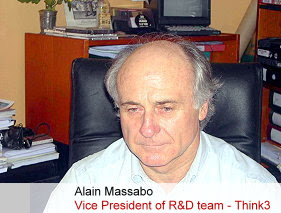
"Think3 AR&D team is currently working on Target Driven Design for tools" - Alain Massabo

An Interview with Alain Massabo, Vice President of Advanced Research & Development team of Think3

1)Considering your rich and long term association with the CAD CAM industry could you please briefly explain the main mile stones in its development till now, the current scenario and the future expectations.

In order to be short: I focus only on the geometric modeling aspects (CAGD) and on commercial products.

I do not consider UI and hardware evolutions except for the future.

We can distinguish three aspects of CAGD evolutions, time-ordered: what, how, why. Each aspect has its own evolution.

* What: it covers what the model represents and the tools to generate the model. Direct modeling is its representative.
* How: it covers how the model is generated and modified (the various evolution steps of the model). Parametric and variational are the representatives with their recent improvement i.e. the synchronous technology.
* Why: it covers why a model is generated or modified i.e. the rationale and the target of a design. Target driven design is its representative.

As far as I remember in time the three aspects evolved as follows:

* What: 2D (middle 70’ in US, Norway), Complex 3D (late 70’ in France), tessellated solid modeling (late 70’ in France), NURBS representation (second half of 80’ in US), “exact solid modeling” (middle 80’ in UK, second half of 80’ in US), global modeling (late 90’ in France)

* How: it is the so-called parametric (middle 80’ in France but not really industrial and robust thus no success, late 80’ in US) and features (late 80’ in US), history-based, variational (early 90’ in US), synchronous technology (second half of 00’ in US).

* Why: it covers the capture of why a design is made. Note that it can coexist with what and how. It encompasses designer’s intent and target driven design (TDD) (late 90’ in France) including analysis and production targets. Design for emotion (middle of 00’ in Europe) and “kansei” engineering (middle 00’ in Japan) criteria once embedded in TDD should allow the combination between qualitative and quantitative targets.

For the future of CAGD tools, I am expecting:

* Multi-modal UI, actual virtual 3D workstations (hologram, vocal command and sound feedback, effective haptic, probably EEG). Hence easier to handle CA-x tools.
* More and more intelligence in models (self-adaptive).
* An equilibrium between parametric, direct and target driven modeling methods.
* A new model representation (due to the limitation of Real number floating point limitation limitations) with new mathematics thus a new set of CAGD tools.

2)Can you give some insights into the new R&D work going on at think3?

Think3 AR&D team is currently working on Target Driven Design for tools:

* To compensate any production process that changes the designed shape and in particular stamping spring-back, shrinking and thermal wrapping for casting or plastic injection.
* To lighter the class A surfacing phase by providing the stylists tools for generating directly class A shapes from:
o An empty screen.
o Noisy measured STL from physical models either for the first generation or to update the CAD with modifications made on the physical model.
o Quick CAS generated shapes.
* To enhance the GSM tool by adding shape constraints.

3)Historically, it is always the large companies that first benefit from new technology. But in the case of think3, can small and medium companies see a beacon of hope?

Yes, especially considering the current W-W crisis!

SMEs can win the global competitiveness and overcome the general crisis through innovation and new technologies.

think3 specifically meets the needs of small to mid-sized companies. Our solutions have been developed listening to their requests and are easy to use and learn, with streamlined procedures and high productivity tools. Our aim is offering to SMEs scalable solutions, assuring fast implementation and fast ROI. We believe that in times of economic turbulence we have to provide more value to our customers and SMEs have to maintain or increase investment in ‘good costs’, i.e. innovation and new technologies.

Innovating through Recession is the way to overcome economic turbulence.

4)In a global economy that is reeling under cost pressures, what is the role that think3 may seek to play to offer competitive advantages to its customers?

We provide at a reasonable cost tools that once adopted in the customer process lead to huge gains.

Gains of more than 90% can be measured.

5)In what way do Think3's India operations contribute to R&D / Innovation activities of Think3?

We have around 100 people in Indian R&D. These people are a key part of our global R&D organization. Some functionality that is requested by large international OEM's in the aerospace or automotive sector is developed in part or totally by this team. In the future this team might become more and more strategic as the competency levels increase.

6)Do you see an untapped potential in Indian design engineers to further expand R&D activities in India?

See above answer.

7)Could you please tell us about the innovative product offerings of Think3?

The innovative aspects of our solutions are:

* Full hybrid system.
* HQ curve and surface generations and modifications among which:
o GSM tools.
o Target Driven Design tools: 1D-2D tension, target curvature plot.
* Adaptive measures.
* Compensator.
* HQRE.
* Vocal commands (unfortunately not yet so used, thus a lack of tuning).

8)Will this work when we have to design complex assemblies with several sub-assemblies, each with many components? Can many people work simultaneously on a medium to large project?

It depends on what is the definition of “complexity” and “many”.

9)Which are the prime target industries of think3 solutions?

The manufacturing industry is our prime target.

10)Can we identify the key differentiators with competing products in the CAD / CAE market space?

In addition to the above innovative aspects there are:

* Integration of 2D, 3D and PLM.
* Parametric (locally optional) and direct modeling.
* Smart Objects (SO).
* COM components available API.

11)Does your product have integrated document management tools? Is it possible to customize think3 to automate customer design requirements?

Yes (PLM) and yes (SO, COM API).

Moreover think3 proposes the TD PLM family of product life cycle management applications.

It is a simple, effective way for managing information, processes and human resources.

TD PLM products are modular and easy to personalize. This makes them ideal for technical engineering offices and enterprise situations where the following items need to be managed:

Parts lists

* CAD documentation.
* Orders during sales activities.
* Design Activities
* Product Maintenance and the management of spare parts and customer assistance.

12)Can you export or import files and models from other popular CAD / CAM tools?

Yes! think3 solutions offer data exchange interfaces with other CAD systems

In fact design and CAD integration is a key point for us and our customers: the continuously increasing pressure to shorten product development, determine the importance of accessing and using design information from any of your CAD system (in your or supplier/customer sites) in a form that enables it to be distributed and used not only in engineering but also by all departments across your and the “extended” enterprise. The 3rd millennium product development process revolves around heterogeneous designs and associated data – making changes, controlling those changes, and communicating their information throughout the company is the new challenge.

13)What are the other 'value adds' that think3 might bring to a customer table - like consulting, for instance?

Yes, we can perform consulting, PLM - PSO customization, shared research projects (AR&D) within a formal partnership.

14)Does think3 promote customer interaction through conferences and events?

Yes, we did it for instance by a paper on compensation written in common with PCI that we presented at a China conference (2002), with HONDA cars where they presented their gains on design quality and time during an Italian conference (Bolzano, 2006) and we continue by contributing to a presentation BMW (in March this year) on compensation.

In addition, during 2009 the Company is going to launch important initiatives to increase Customer Intimacy and collaboration: the CAP (Customer Advisory Program) a table of top international customers that will seat with our R&D with the purpose of sharing views and orient together and according to Market’s demand our future development. Also we will revamp our beta testing community with a project called Quality Accelerator that will wide the number of beta testers in the world.

About Alain Massabo

Alain Massabo is the Vice President of Research & Development team of Think3 since 1999. Think3 is the only supplier to offer technology solutions that combine product concept, engineering and tooling environments. Massabo’s role comes into light as Think3 continues its journey as a member of the consortium to implement the project SATIN which will create history in the world of multisensory modeling. In addition to leading the R&D team, Massabo will now oversee think3 industrial design engineering and apply his expertise to bring further breakthrough innovation and functionalities to think3 customers. Massabo is a pioneer in the realm of complex design technology

Alain Massabo began his career in 1972 in the research and development of computer aided design, manufacturing and analysis tools (CAD/CAM/CAA). In his remarkable career, he’s introduced shape design tools and technologies, initiated several European projects like FIORES-I and FIORES-II (as coordinator), Touch & Design (TnD), SATIN (ongoing) and, Mr.Massabo’s done it all without looking back. He has an expertise in implementation of international projects, patenting and servicing. His success is unrivalled and is the embodiment of good old-fashioned hard work and team spirit. He has successfully managed to maintain a positive relationship with suppliers, research laboratories, universities and University commission. He’s skilled in management of high level teams & various unions.

In his remarkable career, he has been a member of the IMS (Intelligent Manufacturing System) expert group and one of the founders of French CAD/CAM associations. He has been an Invited speaker for the 80 years celebration of Professor Pierre BEZIER (one of the CAD/CAM pioneers in the world).

Jan 15, 2009

PLM can help address challenges that have accentuated because of the economic slowdown

"PLM can help address challenges that have accentuated because of the economic slowdown" - Vivek Marwaha, Director Marketing, Siemens PLM Software, India

"PLM is critical to help companies accelerate time to market, extend returns form products by quickly introducing market driven enhancements, increase product profitability through reduced warranty costs and optimizing manufacturing processes and resources, reduce build costs by minimizing costly prototypes and eliminating manufacturing errors, reuse knowledge to gain efficiencies in processes and eliminate non-value processes. "


1. What are your growth plans and future operation plans of the company in India?

We have been in India, in various avatars for nearly 18 years. By virtue of our long standing presence, our broad and rich portfolio of products and services, our efficient sales and support infrastructure, we have consistently led in the Indian market. We intend consolidating this position further by helping our existing customers augment their PLM deployments by covering more users, digitizing more processes and adding newer applications. We would continue to focus on the mid-market for new customer acquisition, where our portfolio of integrated CAD CAM CAE and PDM solution provides companies with an excellent entry point for deploying PLM with a very quick return–on-investment. We will continue to strive for greater growth and success and stay committed to help our customers gain greater business value from our products and solutions that will help us strengthen our leadership position.

2. What are the new verticals of the market on the radar of the company ?

Our focus continues to be on discreet manufacturing segment, that includes Automotive companies and their supply chain, Industrial Machinery manufacturers, Aerospace and Defense, High Tech Electronics and Appliances, and the Engineering services providers. Having said that , the scope of applications that PLM is addressing is gradually increasing to go beyond the traditional areas of discreet manufacturing. PLM software solutions are increasingly finding application in sectors like Consumer Packaged Goods , Retail, Pharma, Apparel etc. We have already tasted success in these segments at a global level, and would over time explore addressing them in India as well.

3. Could you please explain "synchronous technology"?

Synchronous Technology is the the next big breakthrough in digital product development. It is the PLM industry’s first-ever history-free, feature-based modeling technology, that provides users with up to 100 times faster design experience than ever before. Synchronous Technology allows one to interact with any geometry without being confined by how the model was originally constructed.

The technology is the first-ever design solution that simultaneously synchronizes geometry and rules through a new decision-making inference engine. It accelerates innovation in four key areas:

* Fast idea capture: Synchronous technology captures ideas as fast as the user thinks them, with up to 100 times faster design experience. Designers can devote more time to innovation with new techniques that provide the efficiency of parametric dimension-driven modeling without the computational overhead of pre-planned dependencies. The technology defines optionally persistent dimensions, parameters and design rules at time of creation or edit, without the overhead of an ordered history.

* Fast design changes: The technology automates the implementation of planned or unplanned design changes to seconds versus hours thorough unparalleled ease of editing, regardless of design origination, with or without the presence of a history tree.

* Improved multi-CAD reuse: The technology allows users to reuse data from other CAD systems without remodeling. Users can succeed in a multi-CAD environment with a fast, flexible system that enables them to edit other CAD system data faster than they can in the original system, regardless of the design methodology. A technique called “suggestive selection” automatically infers the function of various design elements without the need for feature or constraint definitions. This increases design reuse and OEM/supplier efficiency.

* New user experience: The technology provides a new user interaction experience that simplifies CAD and makes 3D as easy to use as 2D. The interaction paradigm merges historically independent 2D and 3D environments, providing the robustness of a mature 3D modeler with the ease of 2D. New inference technology automatically infers common constraints and executes typical commands based on cursor position. This makes design tools simple to learn and use for occasional users, driving downstream use to manufacturing engineering and the shop floor.

4. How would synchronous Technology help the Indian Manufacturing & Design industry in its growth?

The advantages of this technology for Indian companies ( for that matter any company anywhere in the world ) can be best be summed as follows :

* The design teams can witness upto 100 times faster design experience
* The design teams can perform ECOs in matter of seconds instead of minutes or hours
* Edit other system CAD data faster than they can
* The technology helps connect people with the most diverse skills across a company’s entire value chain
* With Synchronous Technology companies need not worry about using data from multiple CAD systems

6. How will PLM help organizations during this Global Economic Slow down?

The challenge facing today’s manufacturers is to be able to turn more ideas into successful products quickly and while doing so take greatest advantage of the resources that they have available to them through greater productivity and more efficient processes, all while optimizing the cost and quality of their products. PLM will help manufacturing companies establish an environment to deal with these issues and the product and process complexity that they bring.

In effect, PLM can help companies execute the activities that are required to build the right product and build the product right. Building the right product means meeting customer requirements in terms of time, function, performance, price etc. Building the product right means executing design and production processes that meet the requirements of cost, quality, reliability, sustainability etc. In order for manufacturers to be able to simultaneously build the right product and build the product right they must develop a rich platform of product and process knowledge to underpin and support continuous innovation across all disciplines and phases of the product’s lifecycle.

The bottom line is that PLM can help address challenges that have accentuated because of the economic slowdown; PLM is critical to help companies accelerate time to market, extend returns form products by quickly introducing market driven enhancements, increase product profitability through reduced warranty costs and optimizing manufacturing processes and resources, reduce build costs by minimizing costly prototypes and eliminating manufacturing errors, reuse knowledge to gain efficiencies in processes and eliminate non-value processes.

7. What are the unique features of Siemens PLM ? Why should customers choose Siemens PLM over the competitive products ?

* Our open strategy: Our Software platform is built on open standards to allow for integration between Siemens PLM Software applications as well as with legacy data and systems.
* The scalability of our software solutions is unmatched , be it in terms of performance – from 10 users to 10,000 users, or in terms of capabilities – scalable from a single application to an integrated suite
* The flexibility that our solutions provide customers in their deployment – deploy it out-of-the box or configure and customize.
* Our history of success that is demonstrated by the more than 50,000 customers and 6 million users of our software. With over forty years of existence, 56,000 customer and 5.9 million seats of software the company has been helping its customers to transform their process of innovation.
* We have a strong financial backing from one of the world’s largest manufacturing corporations.We have demonstrated continued strength and momentum in our business performance
* We have the most complete vision and portfolio of solutions in the industry to help companies build the right product and build the product right.
* Our technology, structure and wherewithal position us to lead the PLM market to new levels of value and growth
* And, at the heart of our success, a customer-centric business model where we never let a customer fail.

8. Could you please tell us about your Product development centre in Pune. Does this centre develop and support products for the global market?

The development center at Pune is a captive unit for software product development to work alongside our product development organization spread across the globe. This Development center is strategic and critical for our success;. Far more than serving as a resource pool for doing peripheral work, the center is responsible for complete ownership of many of our software products, modules and service engagements.

9. Which are your major clients in India?

Siemens PLM Software has been present in India for over 18 years. By virtue of the long standing presence, well established sales and support infrastructure, and market leading portfolio of PLM software solutions, we have acquired a large installed base of customers across various industries. This includes leading Automotive OEMS like Maruti , Tata Motors, M&M, Bajaj Auto etc leading Automotive suppliers like Bharat Forge, Brakes India, Sumi Motherson, Subros etc, Machinery manufacturers like BHEL, L&T, Crompton Greaves Ltd. and others like HAL, Navy, Indian Railways, and whole host of small to medium sized manufacturing companies. This aside, more than 300 engineering colleges use our software products to expose their students on these technologies.